
16 September 2026 · The Sonam Pickles family
Sea buckthorn: what it is, and why it grows where almost nothing else does
Sea buckthorn (Hippophae rhamnoides) grows wild in the cold deserts of the Indian Himalaya. What the plant is, where it fruits, why picking it is so difficult, and what we do and don't say about it.
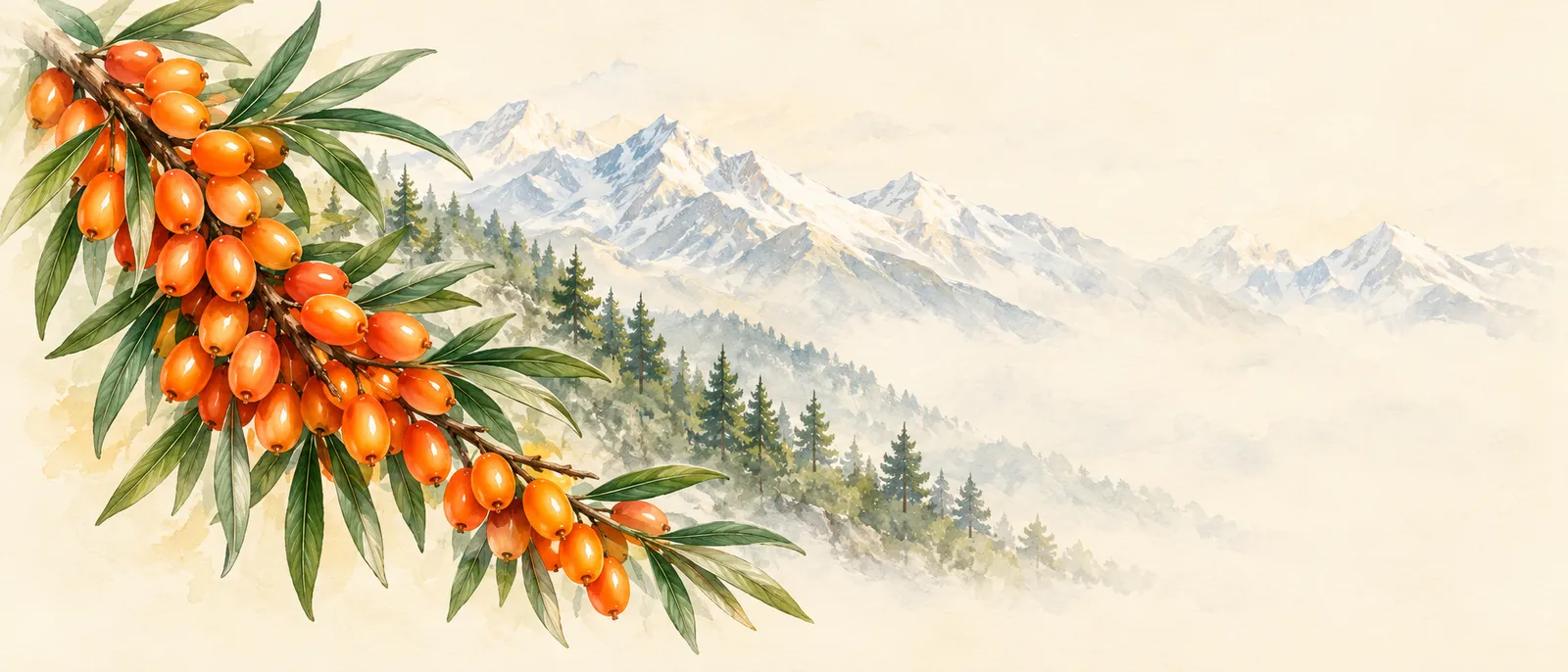
Sea buckthorn as our label artist drew it. The berries really do crowd the branch like this; the thorns are left out, which is the one liberty taken.
If you have driven north out of Kullu, over the Rohtang side and into Lahaul, you will have passed sea buckthorn without noticing it. It does not look like much from a car window. Grey green scrub along the riverbed, a few feet high, the kind of thing your eye skips over on the way to the mountains behind it.
Stop and walk up to one in September and it is a different plant. The branches are loaded with small orange berries, packed so tightly along the stem that they look less like fruit and more like beads threaded on wire. The bush is also covered in thorns, which is the first thing anyone who has picked it will tell you about.
This is Hippophae rhamnoides. In Ladakh it is sold as Leh berry. In Lahaul and Spiti people have used it for generations without any particular name travelling beyond the valley. We press it into a concentrate, and this is the piece we get asked about most, so it seemed worth writing down properly.
A plant that prefers bad ground
Most fruit wants what our apples want: deep soil, water that does not run away, a winter cold enough to set the fruit but not so cold it kills the tree. Sea buckthorn wants almost none of that.
It grows in the cold desert, the stretch of the Indian Himalaya above roughly 2,500 metres where rainfall is thin and the ground is gravel and glacial till. Lahaul, Spiti, Kinnaur, Ladakh. Land that will not hold an orchard. It survives there for two reasons that are worth knowing if you want to understand the fruit.
The first is the root system. Sea buckthorn sends roots down and sideways through loose river gravel, binding it together. In the valleys where it grows thickly it is doing real work holding the banks in place, which is why forestry departments plant it on eroding slopes rather than clearing it.
The second is nitrogen. The roots carry nodules with bacteria that fix nitrogen out of the air, so the plant makes its own fertiliser in ground that has almost none. That is unusual for a fruiting shrub, and it explains how a bush covered in fruit manages on a riverbed where the nutrients wash downstream every spring.
Neither of these makes the fruit better. They explain why the fruit exists at all in a place where an apple tree would die in its first winter.
Why it is difficult to pick
Three things make the harvest hard, and together they set what sea buckthorn costs.
The thorns are long and sharp and sit among the berries rather than away from them. There is no angle of approach that avoids them. Anyone picking for a full morning has scratched forearms by the end of it.
The berries are soft, and they hold on. Ripe sea buckthorn does not detach cleanly the way a cherry does. Pull at one and it bursts in your fingers, which loses the juice and leaves you sticky enough that the next fifty are harder. In colder regions pickers work around this by cutting whole branches, freezing them, and knocking the fruit off once it is hard. That costs the branch, and the bush takes years to replace it.
And the window is short. The fruit comes in late summer and holds into autumn, but the good period is a matter of weeks, in country where a bad spell of weather can close a road.
So the price of sea buckthorn is mostly the price of getting it off the bush.
What it tastes like
Sour, first and mainly. Not the rounded sourness of lemon; something sharper and slightly bitter, closer to unripe apricot with a tannic edge behind it. There is a fruity note underneath that people describe as pineapple or passionfruit, and we can see why, though neither is exactly it.
Undiluted it is too much for most people. That is not modesty about our own product, it is the reason the pack suggests fifteen to twenty millilitres in a glass of water rather than a serving you drink straight. Diluted, it tastes like sharp orange juice with the sweetness taken out.
Sea buckthorn is also thick. The pulp holds together, so a bottle left standing separates and needs a shake before pouring. The label says so, and it is not a formality.
What is in the bottle
We press the berries and we do not add anything. No sugar, no colour, no flavouring, no water. That is the whole ingredient list: sea buckthorn pulp.
The nutrition panel is printed on the pack and repeated in full on the product page, so you can read it before you buy rather than after it arrives. Per 100 ml it declares 58 kcal, 13.5 g of carbohydrate of which 8.2 g are naturally occurring sugars, no added sugar, 0.6 g of fat, and 150 mg of vitamin C. There is also a fatty acid breakdown, which is unusual on an Indian fruit product and which we included because sea buckthorn’s oil profile is genuinely different from other fruit: alongside the omega-3 and omega-6 you would expect, it carries omega-7, which most fruit does not.
Those figures come from the pack. They are approximate and vary a little between batches, because the fruit varies between batches. We say that on the label too.
What we do not say
Search for sea buckthorn and you will find a great deal written about what it cures. We are going to stay out of that, and it is worth explaining why rather than just leaving a gap.
Sonam spent her working life as a chief pharmacist in a government hospital in Manali. Her husband taught medicine in Delhi for thirty years. Between them they have a fairly low tolerance for health claims made by people selling something, and that instinct runs the rest of the way through this business. Our garlic pickle’s nutrition panel comes from a laboratory report, not an estimate. When we found our own website listing a preservative the jar does not contain, we took it off the website rather than adding it to the jar.
So: the panel above is what is in the bottle, and we will tell you that much precisely. What it does inside a person is a different kind of claim, one that needs clinical evidence and a regulatory basis we do not have. Plenty of sellers will make it anyway. We would rather you bought this because it tastes like the mountains it came from and you can read exactly what is in it.
If you want to try it
The pulp concentrate comes in a 300 ml bottle, which is about a fortnight at one serving a day. We also dry the leaves from the same bushes for infusion; they taste nothing like the fruit, mild and grassy rather than sharp.
Both are made in the same kitchen in Village Shim, near Dobhi in the Kullu valley, as everything else we sell. If you want the longer version of who we are, it is on our story.